Design & Implementation of Low-Cost Class-D Amplifier Using PWM
Course: EPC (BEC303) | AITM Bhatkal
Under the Guidance of: Prof. Naveen Kasim📝 Abstract & Motive
Conventional Class-A or Class-AB amplifiers suffer from low efficiency (often below 50%) due to significant heat dissipation in the active region of transistors. To address this, this project implements a Class-D Audio Amplifier using the ubiquitous NE555 Timer IC. By operating transistors as switches (PWM technique), we achieve higher efficiency without bulky heat sinks.
🔌 Circuit Diagram
The system consists of a PWM Modulator (NE555), a Power Stage (H-Bridge/Push-Pull), and an Output Filter.
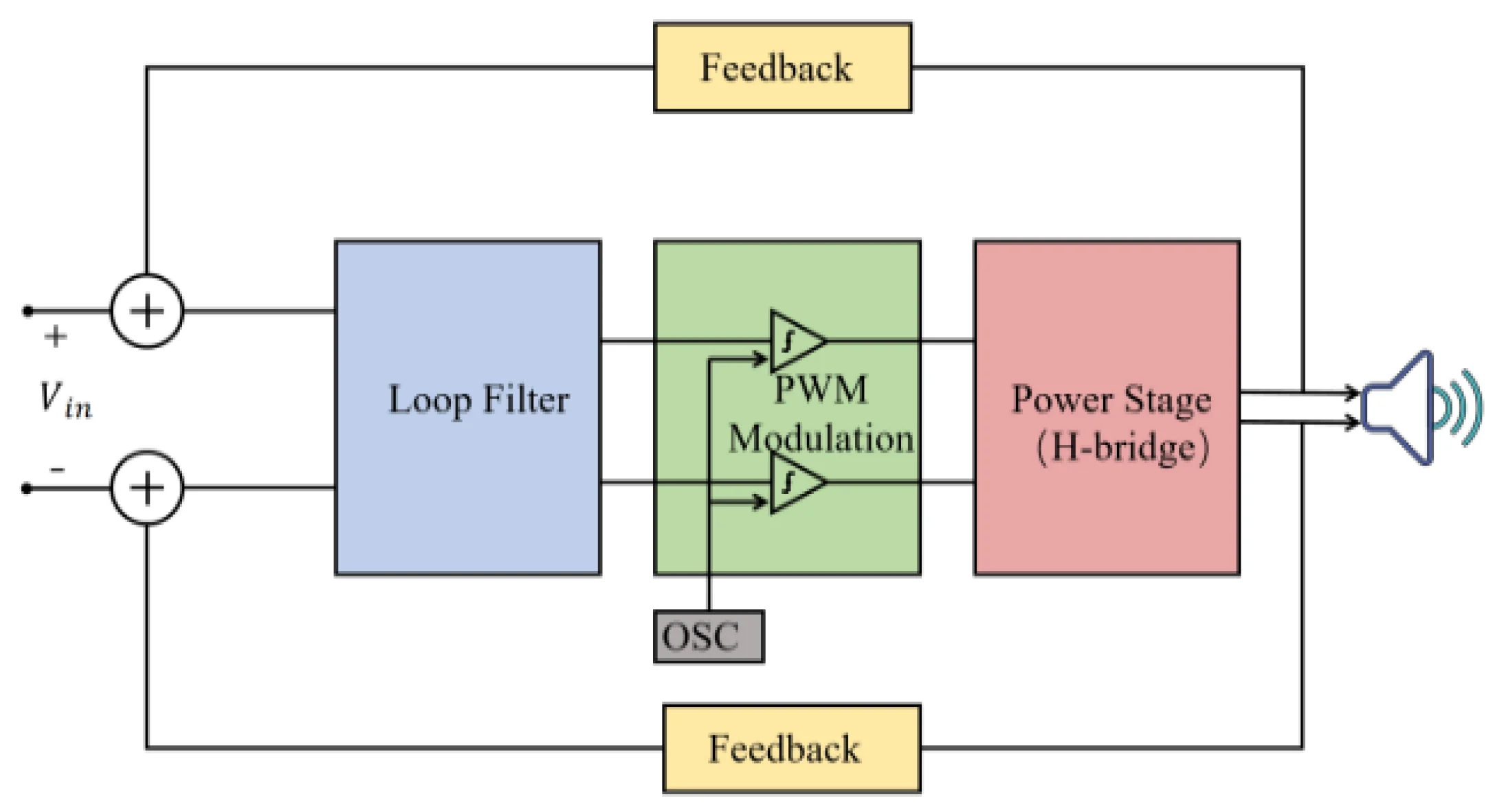
(Fig 1: System Block Diagram)
🧰 Components Used
⚙️ Working Principle
1. PWM Generation: The NE555 timer is configured in a modified astable multivibrator mode. The input audio signal modulates the Control Voltage (Pin 5), which varies the duty cycle of the output pulse train.
2. Switching Stage: This PWM signal drives a complementary push-pull output stage using BD139 and BD140 transistors. These operate as high-speed switches, significantly reducing power loss.
3. Demodulation: A passive LC Low-Pass Filter removes the high-frequency carrier pulses and reconstructs the amplified analog audio signal for the speaker.
✅ Conclusion
The simulation and hardware implementation confirmed that the NE555 can accurately modulate audio signals. The Class-D design successfully operated the output transistors in saturation and cut-off modes, minimizing heat dissipation compared to traditional amplifiers.
🚀 Future Scope
- Stereo Implementation: Using two NE555 timers or a single NE556 dual timer for Left/Right channels.
- MOSFET Upgrade: Replacing BJTs with Power MOSFETs (like IRFZ44N) to handle loads above 50 Watts.
- Feedback Loop: Adding negative feedback to reduce Total Harmonic Distortion (THD).